##Capturing the Wonders of Space
I’ve amassed quite a large amount of gear over the years. My nature is to horde stuff and so with only a few exceptions I’ve hung on to most of it. I’ve now collected enough equipment to be able to build three complete imaging setups. With the limited amount of clear nights we get due to the UK climate, this allows me to maximise the amount of data I capture.
##Mounts
The mount is arguably the most important part of any astrophotography setup. It provides the very accurate tracking require to counteract the Earth’s rotation and without a good quality well setup mount your results will be lacking. I currently have three mounts;
- Skywatcher EQ6 Pro
- ZWO AM5
- Skywatcher HEQ5
The EQ6 Pro is a heavy duty mount easily capable of handling payloads of up to 20Kg. It lives on a permanent pier setup under a specialist cover meaning it rarely needs alignment and on a clear night I can be up and imaging with it in mere minutes. Despite living outside in the worst of the UK weather this mount still provides exceptionally accurate guiding.
The AM5 is one of the newer breed of strainwave mount – whilst theoretically it can handle the same 20Kg payload as the EQ6 it only weighs about 5Kg (versus the 17-odd kilos of the EQ6!). Whilst it takes a little longer to get up and running due to it not being on a pier it’s small and portable.
The final mount is my trust old HEQ5 – it gets less use now that I have two considerable upgrades – but it’s still there on nights I decide to be greedy and run three setups at once!
##Rig One – Main Nebula Rig
This setup is my “workhorse”. It’s small and easily portable which means dragging it outside to the pier to setup is a breeze. It produces a wider field of view than my larger setup and is perfectly suited to larger nebula. It’s coupled with a high resolution monochrome camera and both broadband and narrowband filters.
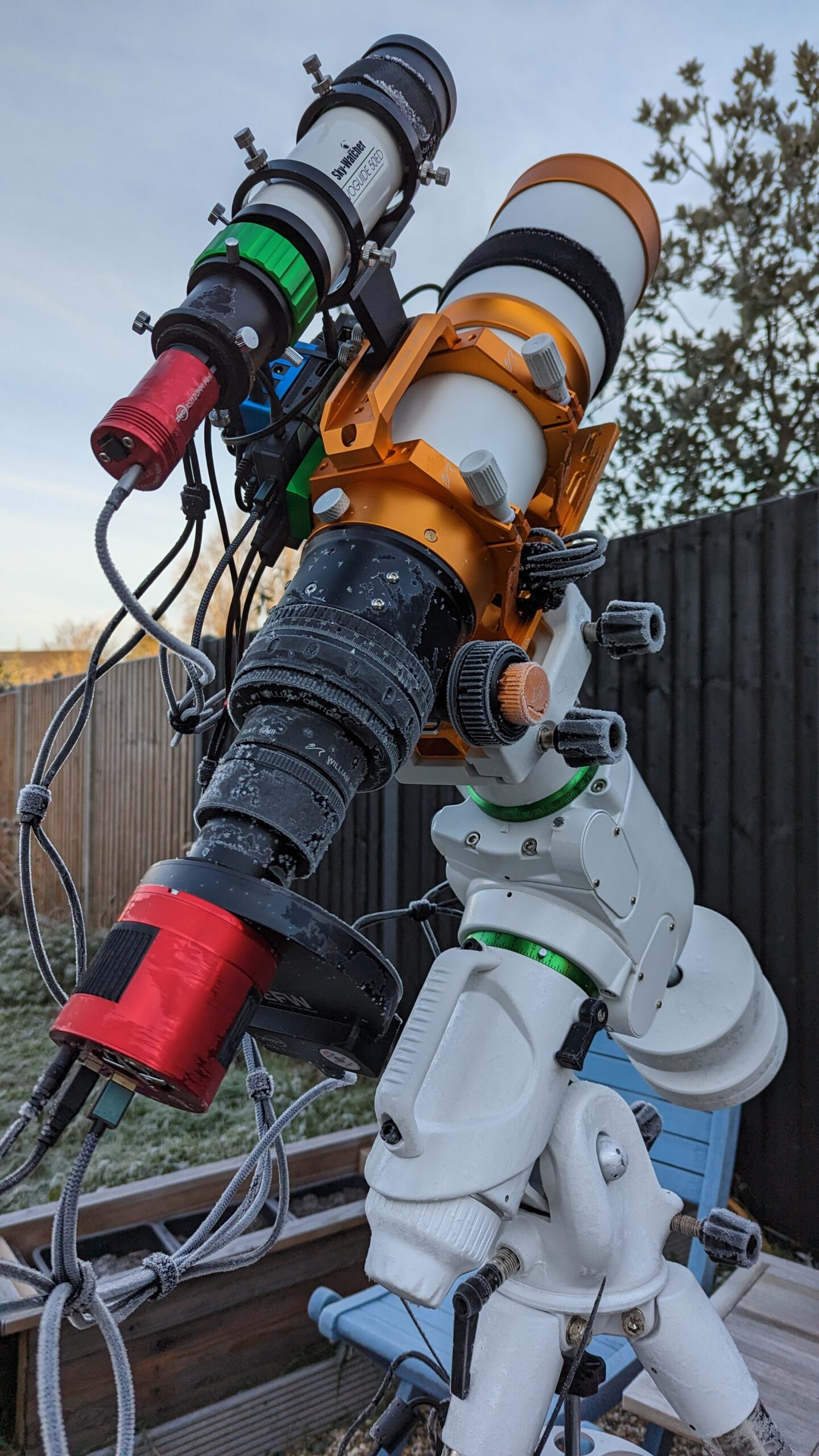
- Telescope: William Optics FLT91
- Reducer: WO Flat6A III 0.8x
- Camera: PlayerOne PoseidonM Pro
- Guide Scope: Skywatcher EvoGuide 50
- Guide Camera: ZWO 120MM Mini
- Filter Wheel: PlayerOne 2″
- Filters: PlayerOne 2″ L,R,G,B,S,H,O
- Focuser: ZWO EAF
- Control: Miele Quieter4 Mini PC
- Power: Pegasus Powerbox Mini
##Rig Two – Bigger and Deeper!
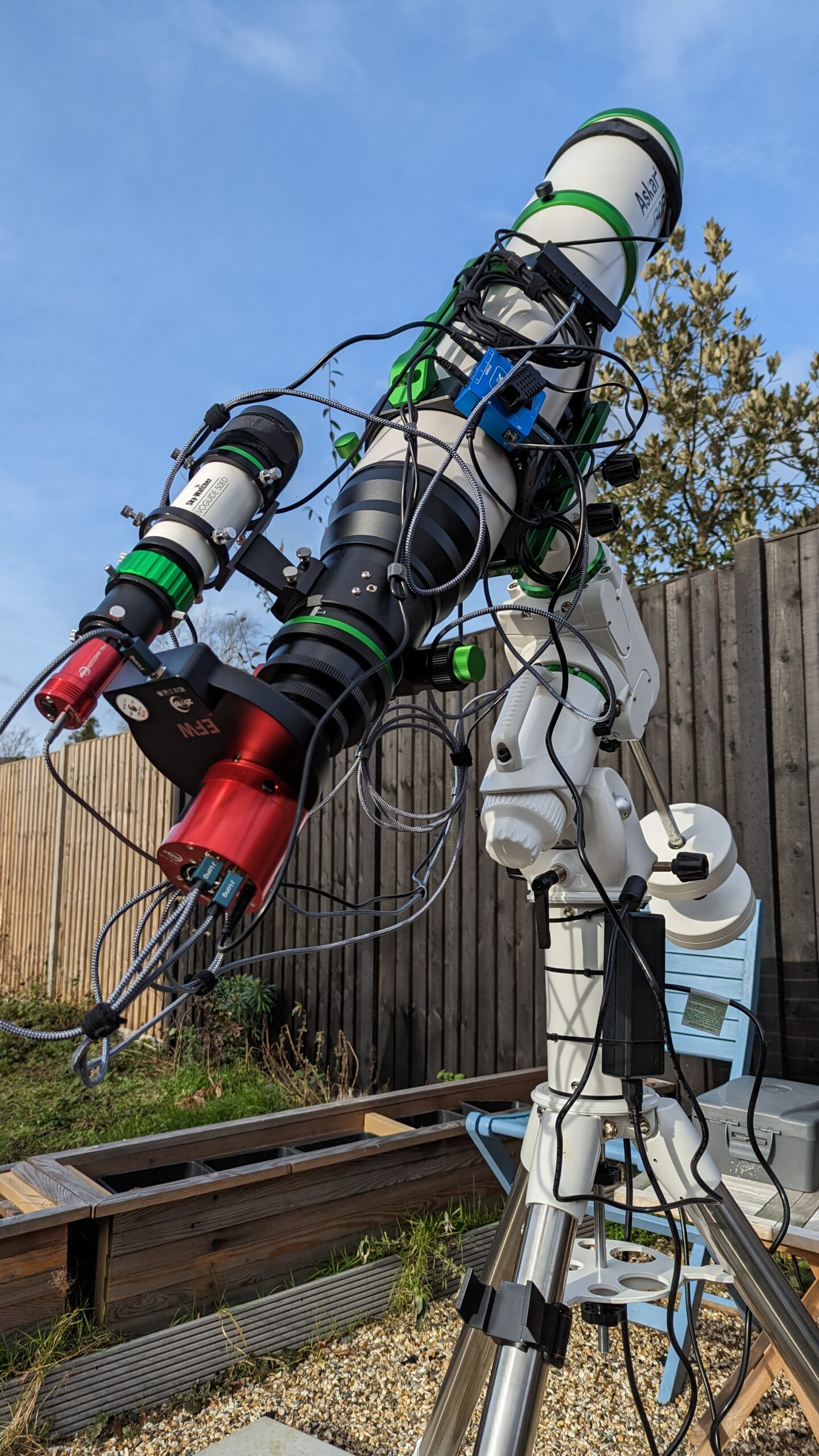
Originally purchased with “Galaxy Season” in mind (the time of year where the Earth’s rotation around the sun means that the normal Milky Way nebulae targets aren’t visible and astronomers switch to galaxy hunting/photograpy). This scope coupled with the small square sensor of the ZWO 533 camera allows me to ‘zoom in’ on smaller galaxies and planetary nebula
- Telescope: Askar 130PHQ
- Reducer: None
- Camera: ZWO 533MM Pro
- Guide Scope: Skywatcher EvoGuide 50
- Guide Camera: ZWO 120MM Mini
- Filter Wheel: ZWO 1.25 EFW
- Filters: ZWO 1.25″ L,R,G,B,S,O Antlia 3nm HA
- Focuser: ZWO EAF
- Control: Miele Quieter4 Mini PC
- Power: Pegasus Powerbox Mini
##Rig Three – Old Faithful!
My original ED80 and HEQ5 combo from 2022 – with some cannibalised parts from other rigs as I’ve upgraded and some cheap bits from AliExpress – but still a very capable imaging setup that doesn’t quite get the love that it deserves!
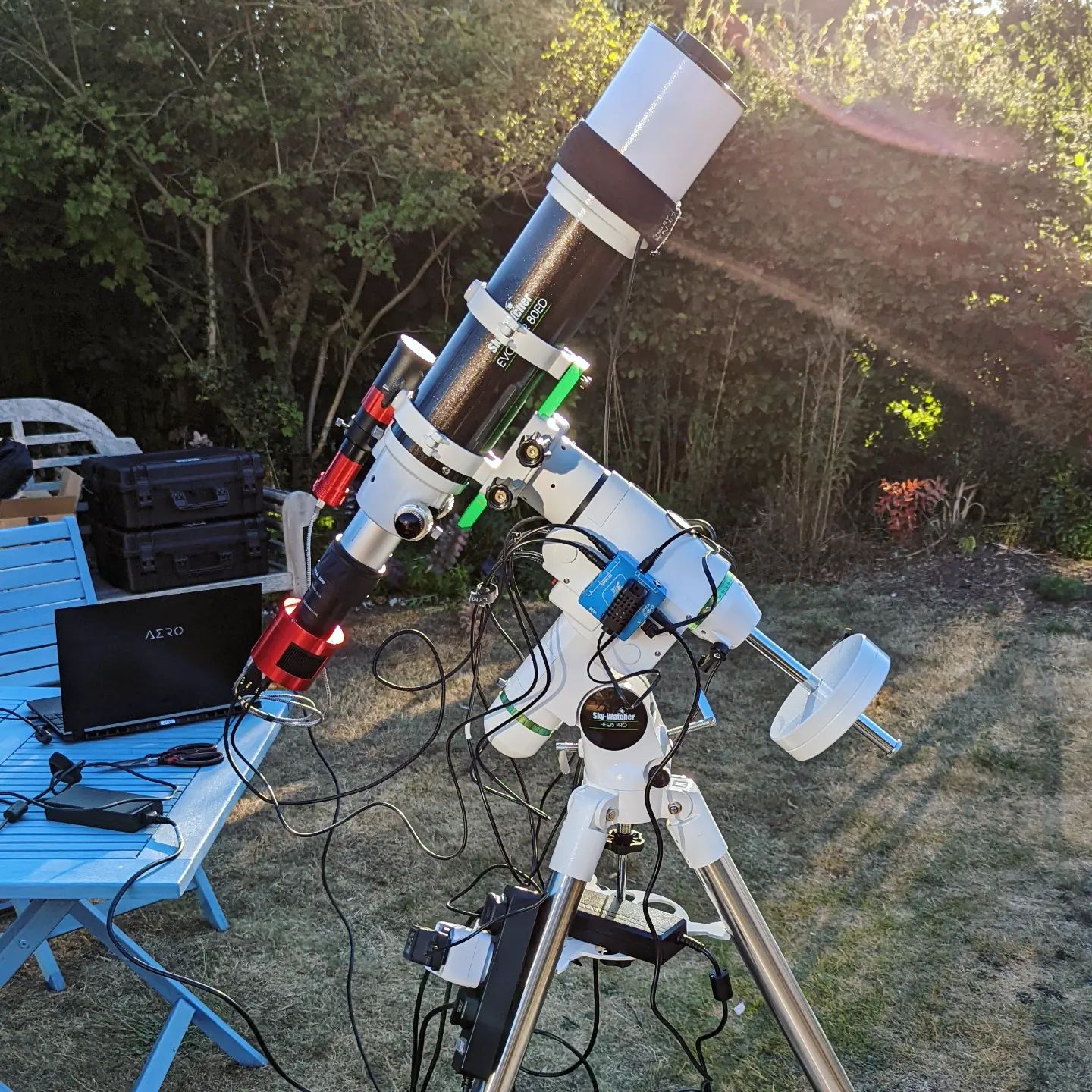
- Telescope: Skywatcher ED80
- Reducer: Skywatcher x.085
- Camera: ZWO 533MC Pro
- Guide Scope: SVBony SV165
- Guide Camera: Altair GPCam
- Filter Wheel: ZWO 1.25 EFW
- Filters: Optolong L-Enhance, Optolong L-Extreme
- Focuser: Gemini EAF
- Control: Miele Quieter3 Mini PC
##Software – Control
I use a small but excellent set of programs to control each of the scopes as they work;
- N.I.N.A // Targeting, telescope control, image acquisition sequencing
- N.I.N.A – HocusFocus Plugin // Focuser control
- ASTAP // Plate Solving
- PHD2 // Autoguiding
##Software – Processing
Data acquisition is only half the battle when it comes to making a great astronomy image. Once I’ve taken the images there is still a lot of work to do to produce a final image. I use the following software and plugins;
- PixInsight
- Adobe Photoshop
- BlurXterminator, NoiseXterminator, StarXterminator
- Seti Astro PixInsight Scripts
- Cosmic Photons PixInsight Scripts
##Links
Most of my astronomy equipment comes from the excellent First Light Optics who I’ve used ever since my first dabbles with the night sky in 2007.
I learned a lot of my techniques from YouTube, Facebook and internet forums – if you’re interested in beginning a similar journey, I’d recommend: